
Lucky
Skill
RNG
Evaluation Report
Lucky
Skill
RNG
Evaluation Report
|
Lucky
Skill Ltd. URL:
http://www.luckyskill.com |
|
iTech Labs Australia URL: http://www.itechlabs.com.au |
|
Suite 24, 40 Montclaire Ave e-mail: info@itechlabs.com.au Glen Waverley VIC 3150, Australia |
|
Lucky Skill Ltd. URL: http://www.luckyskill.com
|
|
Address:
Atho 3 B-C Agioi Omologites P.C. 1087 Nicosia, Cyprus |
|
System: N/A URL: N/A Module: Random Number Generator (RNG) using Mersenne Twister algorithm. |
|
Date Completed: 23 January 2009
|
|
None. |
|
This RNG consisted of implementation of Mersenne Twister algorithm. Our evaluation of the RNG consisted of source code evaluation, Diehard tests on the raw numbers generated by the algorithm and Chi-square tests on the shuffled decks for card games and dice numbers for the dice games. 1.
Source code examination
a) Identification of RNG algorithm;
b) Security of internal state, seeding and re-seeding, thread safety;
c) Shuffling of cards;
d) Scaling for the ranges required for the non-card games 2.
Tests conducted
a) Marsaglia’s “Diehard” tests were applied to 80 million bits of raw 32 bit random numbers generated by the Mersenne Twister algorithm. The following diehard tests were conducted on 2 sets of 80 million bits;
i) BIRTHDAY SPACINGS
ii) OVERLAPPING 5-PERMUTATIONS
iii) BINARY RANK TEST for 31x31 matrices
iv) BINARY RANK TEST for 32x32 matrices
v) BINARY RANK TEST for 6x8 matrices
vi) BITSTREAM TESTS ON 20-BIT Words
vii) BITSTREAM TESTS OPSO, OQSO, DNA
viii) COUNT-THE-1's IN A STREAM OF BYTES
ix) COUNT-THE-1's IN SPECIFIC BYTES
x) PARKING LOT TEST
xi) MINIMUM DISTANCE TEST
xii) THE 3DSPHERES TEST
xiii) THE SQEEZE test
xiv) OVERLAPPING SUMS TEST
xv) RUNS TEST
xvi) CRAPS TEST
b) The following Chi-squared tests were conducted:
i) Shuffling tests for 8 decks of cards. These tests were conducted using samples ranging from 1,000 to 100,000 deals for a total of over 2.5 million deals
ii) Scaling tests for the Dice games.
The RNG tests were conducted for compliance to relevant Alderney Gambling Control Commission (AGCC), UK Gambling Commission, Isle of Man and Malta standards. |
|
1.
Source code
examination.
Lucky Skill Ltd. RNG implements Mersenne Twister (MT) algorithm. 2.
Tests conducted
a) Marsaglia’s “Diehard” tests b) Chi-squared tests
i) Shuffling tests
ii) Scaling tests for the specified ranges |
|
1.
Thread safety: If multiple threads access a single instance, access should be synchronized externally. Or alternately, different threads must use different instances of the RNG. |
|
Date of
Certification: 23 January 2009
Software provider: Lucky Skill Ltd Total number of pages: 6 |
|
iTech Labs certifies that the RNG (listed in Appendix-A) comply with Alderney Gambling Control Commission (AGCC), UK Gambling Commission, Isle of Man and Malta standards subject to the conditions in section 10 Conditions. |
|
1.
The source code provided to iTech Labs (as per Appendix-A) must be used for compilation of the RNG module. 2.
While using the RNG, the issue identified in section 8 Observations should be satisfied. 2.
Any change to the RNG source files listed in Appendix-A must be verified by iTech Labs. |
|
While it is not possible to test all possible scenarios in a laboratory environment, iTech Labs has conducted a level of testing appropriate for a submission of this type. Accordingly, subject to the above comment, iTech Labs certifies that the items under test comply with the relevant Technical Standards, unless otherwise stated. |
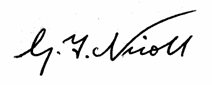

Geoff Nicoll Kiren Sreekumar
Principal Consultant Principal Consultant
iTech
Labs Australia iTech
Labs Australia
23 January, 2009 23 January, 2009
Appendix-A
Click here to view the Original iTech Labs report.